Sunday, February 23, 2014

Meet the Meat Puppets

Cris Curtwood and Curt Criswood, the Brothers Kirkwood

Just last month, Procrastacritic glanced away from TV and TV-grade cinema to take up music, to the surprise and delight of none. Seems like the perfect time to respond with another D-flat foray. Also, an opportunity to expound on family and freedom.

The Meat Puppets came to my attention in 1984 or so, when I was a college radio station DJ at WAMU, then wired into the dorms and thus free of FCC regulations. The previous year, I'd used that freedum to play a shitload of "fuck"-ridden punk rock songs, but with a new and rotating caste of co-hosts, I explored the stacks of LPs and branched out a bit. Still in the thrall of hardcore, though, I'd pull out punk-sounding names only to be led astray, inadvertently hypnotizing myself with the Stranglers and floating away on the melodic riffs of the Meat Puppets.

Today, my daughters are a bit horrified/scandalized by the Meat Puppets' moniker, but not entirely immune to the instrumental flow of "I'm a Mindless Idiot" and other songs on an ipod. Back then, it was "Up on the Sun" on vinyl, which of course I stole from the station, rationalizing that nobody else appreciated it.

Multi-generational Kirkwoods, and Da Drummer. Enjoy that spotlight, Elmo.
Fast forward to now. Or a few months ago, which is Now in procrastincation time. I had once again finagled fieldwork in reach of civilization, featuring a concert by the Meat Puppets, alive and kicking (and, incidentally, DJ Bonebreak of X drumming for the opening act!). So alive, in fact, that the Puppets demonstrated reproductive fitness and evolutionary success in the form of a Kirkwood son playing with the band. More on the possibly moron son later.

But in the meantime, let's talk about UNcle Cris, on bass. Probe the internet, and you'll find all kind of stories about his ups and downs, but when I saw them, I hadn't peeked. All I saw was,....HOLY FUCK! A kickass player. Way into it, way good. A face lined by experience beyond mere age, he looked like fucking Charles Bronson, defying death, blasting out the beat, iron-man stomping across the stage. Seriously, looking on from right in front of the stage corner, all I could do half the time was stare past his brother on guitar (no mean feat, given the 6-string antics) and bask in the thrall of a giant. He looked like he'd picked up a full-on acoustic bass like it was a guitar, plucking the hell out of it. He laid waste to complacency.

Meanwhile, the guitar. Uncle Curt, melodizing. Chill. No rock-star clothes, just sweats and shoes worn comfortable by years. Fingernails glowing in whatever lights the house had going as they danced across the frets.

And on 2nd guitar, Kirkwood son Elmo. For some reason, he had fairly consistent banter-beef going on with the audience on that side. Maybe there was some obnoxious fan settng him off, but from my end, I had to wonder why he was so fucking belligerent. I mean, you're 20-something, it's the 21st century, and you're making a living playing music, which is kindof a miracle. Thank your dad and uncle for their decades of setting the stage, and deal with being 2nd or 3rd banana, kid. Yes, people are there to see your old man, and yes, you can play those riffs too (maybe), but no, you are not lead. Play rhythm and thank your lucky stars. 

Wednesday, January 29, 2014

Matchstick Men in Picture and Song

Matchstick men in fluid convergence

I was not quite 3 years old when Status Quo released their song "Pictures of Matchstick Men." Not quite 3 years into college (a time I refer to as my Second Sophomore Year), I heard the Camper Van Beethoven version. I love both, and not quite 3 decades later, it's about time to tackle the topic here.

In the usual google lead-up, I learned that there is a Nick Cage (not his real name) movie called "Matchstick Men," but I've never seen it, and cannot stand that guy. So much so that I will not succumb to the temptation to snark the hell out of him. Nick who? I forget, except for the withered appendix of my memory that still hates him for turning into such utter shit after getting my hopes up with Raising Arizona.

The other web-search surprise was learning about L. S. Lowry, the British artist whose paintings were chock full of angular people who came to be termed "matchstick men." I've not read art critics take him on, but wikipedia implies that quite a few of them wrote him off as a naive, not highly accomplished, artist of the ilk that insiders like to call Outsider (but without the allure of insanity or melanin-enriched ethnicity). Apparently he refused a knighthood and several other honors, so I'm inclined to admire his outsiderness.

What strikes me, though, about his paintings is not the angularity of the individuals, but the fluidity of the collective. Dozens or even hundreds of people walk through the frame, stiff in microscopic isolation, perhaps, but in the whole view of the painting, they illustrate the fluid dynamics of crowds. Converging on a football game as above, or streaming out of factories, weaving through plazas, eccentrically erasing grids.


Crowds of individuals, each maybe set on a line, collectively chaotic, but still expressing a Flow. Good paintings to squint at or view from across the room. Approach closer if you want, focus on an individual or a family (despite their simplicity of form, they are individuals, not a Waldo among them), but for me, the box of Matchstick Men scattered across the canvas of industrial Britain is more interesting.

I cannot really guess what Status Quo was aiming for with their song. Maybe just fame and money, maybe a message. What they hit was a psychedaelic nerve, and their song has been played and played again for decades. Not complex, "naive" perhaps, but an alluring and persistent flow.

Lowery with an "e" and Campany
Then there's these guys. Older than when they covered Pictures of Matchstick Men, and apparently much more sensitive to light, what with the sunglasses. The Camper Van Beethoven version of the song is one of those few covers that exceeds the original without being a radical departure. Faithful covers so often fall into the tepid soup of mediocrity, but not this one. Not that it's without original flourishes (especially live), but the simple power of the original riff cannot be abandoned and still be the same song. Alls I ever hear is it and you.


Wednesday, May 22, 2013

Playing with Feu: Quest for Fire

The real Planet of the Apes, Neanderthalensis style.

For four months, I've been at a loss for someone or something to procrastacriticize, until last night, not feeling like doing anything, even sleeping, I found myself watching the answer on netflicks. A movie I saw when it came out and I was a teenager, not paying attention sufficiently for it's lessons about prehistory and evolution to sink in. But I did remember Rae Dawn Chong, that all the dialogue was in a cave-man language invented for the movie, all the scenery natural, and that it was not a musical. Any two of those are enough to make me watch, even if it were not such a contender for Archaeological Training Film status (others of the ilk appear here).

There's not much to complain about with Quest For Fire, even the weird translation of the original Guerre to Quest. Yes, instead of to deserving and starving grad students, the jobs of developing the languages verbal and non for multiple hominid bands went to a celebrity linguist and celebrity ethologist (yes indeed, such creatures exist), but what other feature films even make the effort? Same goes for anthropological inaccuracies.

Now QFF (yeah, I'm gonna start acronymizing it,...makes me feel nerd-cool), for a movie that has high standards for acting and cinematography (for starters), does also have some glaring lapses. The fight with the Wuggaboo tribe, for example, comes off like a farce (the first of many appearances of some of the fakest and poorly deployed "blood" in the 1980s occurs in this scene), complete with the old Batman Show knock-down-three-guys-with-one-log maneuver and platice clubs that are exact replicas of the one wielded by Bam-bam Rubble. Then, lots of close-ups of wolves with rasberry jam (or maybe blood?) on their snarling faces, shot on various film stocks before two huskies finally enter the real scene, chowing on a dish of kibble put right behind a beteljuice-smeared (or, possibly, bloody?) "corpse." These lobos are not only not Dire, they're probably not even a match for the "saber-toothed tigers" (you guessed it, a pair of lassitudinous lions with spray-on stripes and plastic fangs). 

Apparently, fake blood is not considered make-up, because QFF took home the academy award for make-up that year.  Maybe body paint on the more advanced tribe (which caused the guy having to rub it on Ms. Chong every day,  a latent heterosexual, to feel conflicted and uncomfortable) counts as make-up. And I guess the girl with part of her arm cut off ("You don't eat a long-pig that good all at once," as they say) was frighteningly realistic.

What is the most stunning about the make-up Oscar is the little-known fact that the principal actors did not require make-up, having been cast for their browlines. Both were at the beginning of their film careers, and both did a fine job fighting and walking and yelling and grabbing females from behind. The lead was none other than Everett McGill, who was in TV show Twin Peaks as Ed, the guy pining for his high school sweetheart and almost getting her before (as will sometimes happen in a David Lynch story) the spell wears off.

Of course this shot is low-res. It was 80,000 years ago, so I had to do a capture from VHS.

McGill may have been the lead then, but his second-banana turns out to be Ron Perlman. I looked up Mr. Perlman, and that guy has been in more things than any other actor I've seen. And he's not just cast for his Beastly beauty, Neanderthalish brow, and Hellboyish charms, either, he's in video games, and does voice work. Hey Arnold, even. Now, he is best known for being the thug-in-chief emeritus in Sons of Anarchy, however, and brooding beneath that brow didn't hurt his chances landing the role of what is basically a modern cave-man character (Ugh...kill now). The main difference is that his QFF character is repulsed by cannibalism and only does it accidentally. 

One thing about this movie is that only a few people play roles amounting to more than Nameless Tribe Member. In the contrasts between these groups, QFF's vintage betrays itself most clearly. The most primitive group are the Wuggaboos (yeah, another spelling seems to be the "official" way, but transcribing an 80,000-year-old fake language is not as exact as you may think, and my spelling comes closer to the slur-like character the name was bound to have had). And guess what? The most primitive hominids also turn out to be the black ones. Oh, and they're hairy, too. It's becoming less common these days to be so overtly and clumsily racist, but making fun of the hirsute in their hairsuits is just as accepted now as it was then. Alas.

Then there's the cannibal tribe, who appear to be more or less Scottish, or maybe Irish,...some kind of violent redheaded stereotype. One rung up from African, in 20th Century "Reason," but not up to par with the heroes' tribe, which the internet seems to agree were Neanderthals. QFF manages, within the Neanderthals, to bring in an element of hair-snobbery by reversing the Wuggaboo effect: the guy whose character arc goes from nerd-we-will-trust-with-fire to buffoon to scapegoat is the only bald guy in the movie. Only losers go bald, as we all know.

Then there are the more advanced Cro-Mags, with their body paint, variety of sexual positions (including one the women might even enjoy!?), intoxicants, and out of control laughter. In fact, if it weren't for the advanced weaponry and monochrome body paint pallette, they would appear to be hippies. And in the spirit of love and acceptance, they're the only multi-racial group of the movie. Oh, and they know how to make fire. 


Fire will dawn (as soon as he let's her handle the stick properly).
So the Quest meets with success. And we all learn something. Mammoths respond to little gestures of kindness. Australopithecenes and Neanderthals may fall into racist stereotypes, but modern humans are diverse (beneath their uniformly black and grey paint). Living with fire is better than living without it, especially on tiny bog islands (and the corrolary: if fire is that important, maybe you should get the hell out of the swamp). People with too much or too little hair are bad. Technology makes life better (or at least it did until the atlatl set of an arms race that is not yet done, but I think  that's more my opinion than QFF's). Getting hit in the head with a rock is funny. And, to step outside the story for a moment, that good actors keep their real names (Chong, McGill, Perlman, I salute you all) and can still have a decent career.

I am glad I learned so much watching Quest For Fire this time around. I feel like it has made me a better archaeologist, and just maybe a better fake critic. Maybe in another 30 years or so I can watch it again, and learn something new. I'll post if I do.

Saturday, January 12, 2013

3 Generations of Blue Steel

One of the best things about losing touch with Classic Rock radio is that I don't have to hear the Doors slam the coffin shut on psychedaelia. Their nauseating drone of pretense! Tonight, I happened to hear "Don't You Love Her Madly" and hated it happily, pointing out to the girls that it is nothing but a ham-handed mash-up of music from one of those phony old-timey ice cream parlors and a barbiturated lounge singer.


James T. Morrison, actin' all deep and groovy and shit.

Mr. Morrison, front man extraordinaire, even said he was the Lounge Lizard King ("Lounge" was silent, but implied), and he is correct. Had he lived, he would be splitting his time between Atlantic City and Branson, always wearing giant shades to hide shame's bloat, driving away musicians and yet continuing to score groupies with his trademark blend of booze and abuze. 

He didn't live (and thus stayed young and famous while his peers became crones), but even a dead guy can stare out of print and pixels into the eyes of human hordes years later, enticing them to look up his fauxlosophical lyrics and poetry. He was photogenic, if nothing else, and in posession of a fine sense of how to make a silly gesture seem deep, like in the shot above. You may also notice that he's got the soft proto-70's version of the Blue Steel pout. The Lounge Lizard King lives not more, but Jim Morrison Male Model achieved immortality.


Henry Garfield by Thurston Howes. Check out his  gallery o punk photos.

Modeling involves posing, and one thing punks hate is a poser.* Actually, no, that's not true. It's just that the band had to have more that one pose, and it wasn't about being pretty; Blue Steel would not have cut it on stage. A singer in particular had to have a series of poses directed at the other players, the audience, and imaginary oppressors. Henry Rollins was pretty good at that, but could also be insufferable. The kind of guy who would pose with a book so people would see him and then he could tell them what it means (instead of reading it), or write about He Himself and what He thinks.**

Like Morrison, Rollins loves having cameras on him. Not being a druggie alcoholic, he lives to do it to this day, in a manner I've posted on before. He poses even when not on stage, like with his Blue Steely gaze above, shirtless and one shoulder dropped, just like he did as a kid in front of his Doors poster, alone in his room dreaming of being a star). But in all those years it's hard to find a candid shot. Frame after frame he poses, so we won't forget his face. Line after line he proses, so we can grok his enlightenment. Track after track he chooses, so we're immersed in his sensibility.


I guess now I am too old and unhip (a word that proves my point, I think) to know who is this generation's self-adulating intellectually pretentious pretty boy of music. But I do know who Derek Zoolander is: he's the man who perfected the look that Morrison and Rollins only approximated.

And that's not all he perfected. By throwing himself whole-facedly into his modeling career, jettisoning the need to be loved for his mind as well as his really really good looks, Zoolander became a better model than Henry or Jim, and way less annoying. Not for the inventor of Magnum to write pretentious crap, or to whip out a tome to be seen reading the right stuff. All he wanted was for the school for kids who don't read good to be big enough for them to fit in. A simple man, a grounded dream. Isn't that enough to ask of our models and our musician-models and model-musicians?


* I know, poseur is the 'real' spelling, but people who insist on that brand themselves with it.

** Like me, now. Dammit, I'm a fraud.***

*** But there is this silver lining: Now I can claim to be a legit critic.

Monday, November 5, 2012

What Brings You to Procrastacritic?


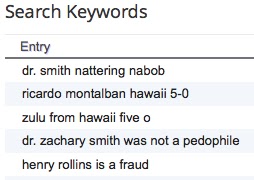
One week last month, these were the top searches leading here. 
 
I have never been so proud. It could have been better only if "jack lord fake name" and "joe dirt underrated masterpiece" also showed up. But about this list,...no, this poem,...I will not bemoan. I stand by it...at least until Mr. Rollins hunts me down and crushes me with his patented Bicep Vice-grip move. 


Wednesday, October 24, 2012

Rambo (part __)

Resplendent in Ralph Karen hand-woven headband, Rambo heads up river.
It was a summer evening in northeast Washington state, wavy heat rising from the pavement outside the hotel, where some channel had a Rambo marathon going on. I thought, "Great. I haven't procrastacriticized Rambo, and it's about freakin' time."

Then a couple of things happened to waylay me. One was learning that the Rambo I was watching was not from the '80's but a mere four years ago. But that wasn't what stopped me. It was learning the very next day that Stallone's son had died. Even though nobody looks at this blog, picking on the grieving seems mean even for a blog critic, so I gave it a break. I feel for him, and cannot imagine that kind of loss.

Rambo, however, is an imaginary guy, even more so than Rocky or Sly Stallone his own self. In the confusingly eponymous 4th episode (at least they decided to stop the even more confusing "First Blood Part __" titling), John Rambo is near Burma. Presumably in Thailand or Laos, although I could tell most Americans he was in Vietnam or Guyana and it would make no difference.

Now, he is a reclusive villager (a feat tat only w Westerner can pull off), spending his days catching snakes for the locals to use in their tourist shows, in a place where the rain only ever stops when he wants to do some face-acting. For some reason (I'm thinking it must be common sense), the locals prefer to have a crazed vet do their cobra-catching, and I even suspect that they invented the whole snake-show thing as a way to put this uninvited psychopath in harm's way, hoping the problem would solve itself. Instead, they end up having to complain that enough cobras are in custody, and they'd like to get some pythons; Rambo has been so effective a snake-catcher that the village is soon to be devoured by rats.

Admittedly, I an no expert in the economics of snake-catching, but I have to assume that the villagers are horrible snake-keepers or Rambo is secretly killing the serpents at night, because otherwise a once-daily snake show would not create sufficient demand for a snake-grabber bringing them new talent day after day, earning enough to afford a boat and nice archery gear. Unless, of course, the people really were trying to kill him and divvy up his stuff.

Or maybe he supplements his living by blacksmithing. John J Rambo, brooding and Thorish, pounding rebar into propellers. Later, as he prepares to do battle, he makes a machete. In a jungle country, where machetes are the single most common metal tool and the closest rebar is in Yangon, hmmm. Makes no sense, until you ponder the depth of the man's self-sufficiency, the scope of his killer artistry. No store-bought blade for him…not a chance. I can respect that.

So then along come the missionaries. The movie failed to portray them as being drawn to his snake-handling abilities, which was disappointing. Instead, they just want to sneak them into Burma to help tribespeople who are being persecuted because they are Christian (and oh yeah, the wrong ethnicity). Clean-cut do-gooders clearly disgust Rambo, who is too wise for that peace and love bullshit. The intensity of his dismissal, of course, can only signal a turn-around, and the fact that one of the missionaries is a pretty female can only mean that Rambo's heart will melt, and that we are all about to learn something.

What we viewers learn is that by 2008 the effects, if not particularly special, are more convincing than in First Blood Part I, or II, or probably even III. [Oh the redundancy, it reminds me of that time I saw in a friend's footlocker of porn the title "My First Time, Part II"?!] Every lead-hitting-flesh shot seems to be individually miked, and both the injuries and corpses seem more realistic than at the dawn of the Rambo Age. This installment reportedly has the highest body count of any in the series, and we are treated to everything from fresh dismemberment to pig-gnawed bodies to blowfly-bloated bodies. Two thumbs up for realistic carnage.

Not so much for the dialogue. Rambo remains speech impaired, and prone to saying things like:
"when you're pushed, killin's as easy as breathing'"
or
"there isn't one of us who doesn't wanna be somewhere else…but this is what we do...live for something, or die for nothing" (his longest speech, I think).

Rambo does not want to go with the woefully unprepared and naive Jesus freaks, and warns them against entering a war zone. Of course they do, and of course he ends up going in to save them, cajoled by their preacher (the White Shadow!) into joining a group of mercenaries hired with the job. Rambo is aloof, though, and clearly sees this whole episode as an imposition on his usual snake-catching gig; he is not  one with the mercenaries, and we see that he is better and wiser than they are.

Rambo guides his boat up-river to the…yawn…heart of darkness. There are no heads on sticks or acid trips, just some pirates with slow enough reflexes to be dispatched easily. The hot missionary's milquetoast guy friend objects to the killing, warning Rambo that he will report the murders, which we should all immediately recognize as foreshadowing to his subsequent bashing-in of a Burmese guy's head with a rock. With typical understatement, Rambo responds with"They would've raped her fifty times... and cut your fucking heads off! Who are you? Who are any of you?"

The whole movie is like this. Stallone recognizes hypocrisy and loathes it, but deals with it though subtle writerly devices like head-bashing and mass murder.  Or men of god who hire mercenaries, who turn out to be not that good at fighting. Oh, and of course the evil villain who wants to 'purify' Myanmar has a thing for young boys…genocide is not quite bad enough, so you gotta throw in some pedophiliac buggery to make it clear. I keep wondering what would have happened had a young Stallone been handed a dictionary instead of a copy of armaments catalogues and boxing videos; what if he had gone for a refined message, instead of escalating body counts?

At some point after said body count topping 200, after he gets to use his hand-forged blade on the evil Myamarmy, after he delivers the missionaries to safety (having taught them to not be so damned peaceful and self-righteous), we see that Rambo has finally made a breakthrough. He returns to Arizona to find his dad; he is ready to step out of the heart of darkness. Or maybe he's just tired of cobras, and wants to try his hand at rattlers.

Godspeed, John Rambo, Godspeed.

Saturday, September 8, 2012

Front Man Capitalism: Precrastacriticizing Henry Rollins

The Magnificent Creature known as Henry Rollins, bottom (Artist's conception by Coop)
Henry Rollins is a comin' to town soon, which means I should review the show several years from now, but this time I'm going precrastacritic, because I ain't going to the show anyway. May as well pre-judge (as per childhood religious training).

The reason I won't go see this icon of American Hardcore punk, this spokesman for the outsiders, is that he's gonna charge more than I've ever paid to see anything in Olympia, and has the gall to call his tour "Capitalism," in which he goes to the capital of each state (get it!? Pure Henry Gold) and talks about the injustices of capitalism that he has seen in his world travels.

People my age came to know Henry as the singer of Blag Flag, a seminal band which became that way under Dez, but hit punk fame (translation, suburban demi-rebels like myself were able to buy the album) when Damaged hit the record stores, overwrought Henry photo on the cover (he's punching a mirror!). Then he had to have a band named for himself, showed up on a bunch of cable shows and the movie blockbuster Jackass, did whatever it took to make a living without ending up as the burger flipper he sometimes says he was set up to be. 

But instead, he's a "spoken word artist," a phrase that, when translated from it's native Capitalistian, means, "I don't like sharing the take with a band, and I'm more of a visionary/poet/raconteur than a musician."

And I am supposed to pay five times what I would pay for a Fugazi show to take in this one guy, no smarter than Ian for sure, and without the music. He did promise Capitalism, so I guess I shouldn't complain.What sucks is the "I'm with the proletariat" conceit. I watched the video linked to at the calendar that announces hi Olympia show, sitting through  11 excruciating minutes of him talking about how his free-spiritedness and tough upbringing made him qualified to work in the service industry at minimum wage, and thus is my brother.

Bullshit, Henry Garfield (yup, Rollins is a made-up name). Were you street-wise, or a student at the elite Bullis School? Were you earning your blue collar cred while working at a Haagen Dazs ice cream store back when the name meant luxury to the rich, and a complete blank to the rest of us? You like to talk about how close you are to the edge, but you say you've been on tour more than 100 days this year, each time a few hundred people paying 25 bucks a pop to hear you claim that you're just a poor working stiff. 

But you're not cleaning piss in a public nursing facility, and you are not flipping burgers or even slinging yuppie ice cream. You are, as you mostly have been, starring in the Henry Show. Appearing and voicing over, DJ-ing and blogging. Lots of it at henryrollins.com (not .org, .net, or even .us, but .com, just to be clear), where the rest of us can also buy t-shirts with the Henry birth-date emblazoned on them, again for the low low price of $25. Ignoring for the moment the creepy cult-of-personality vibe of selling stuff celebrating the Adored One's date of issue, I'm sure that the reason the shirts cost so much is that they are made in a unionized American factory. 

To harp on the website a moment longer: why is Capitalism so much more evident than that there Freedom you claim to love and defend? The "Dispatch" blog allows no comment, no democratic feedback, and when I get to the "Contact" page, most of the addresses are for money stuff. The approach seems to be, "I am Henry. Now shut up and listen. Or buy something." I wonder too, how far your internet power extends, since I posted an abbreviated rant of this sort at the Olympia Film Society's page announcing your show, only to have it never appear.(Maybe there will be something tomorrow...I tried again.)


However, I do get to see this poster, featuring you as Uncle Sam, co-opting our nation's most scoldy icon to sell tickets. Clever, very clever. And better than that "I copied it from Johnny Rotten" crazy-eyed stare you do; the Uncle Sam pose demonsrates your versatility. Also, it's a welcome relief from the muscle guy stances you seem to favor, looking like Napoleon's Uncle Rico, only meaner. 

Meanwhile, you are making your way here as I pre-criticize. Honolulu to Anchorage to Olympia, and you've traveled all over in months and years preceding. Ergo the "Dispatches" trope on your .com website. We imagine tuning in to read your tales of exotic travel, global humanity, and regional complexities. But mostly there are plugs for your radio show and appearances. Since I know something about Honolulu, I was happy to see you posting from there, but was disappointed to see you only plug away and write boringly about the logistics of traveling shows. There was no there there. Not even any Henry there. If you just wanna phone it in, give up the blog and tweet.

The people who do go see you will enjoy it, probably ($25 is a powerful inducement to feign satisfaction for most of us, Henry). Hell, I enjoyed Black Flag (most recently a half hour ago, on the original vinyl), and actually would rather abide a show-boating, only slightly ripping-me-off guy who speaks out against corporate corruption than most of the alternatives. 

But your being a disingenius is bothersome. Why not admit you were born weller-off than many, that your service-working years were spent in an upscale establishment, or that maybe you got the gig with Black Flag because you had the resources and the parental indulgence to goto NY city to be at their shows for nights on end? People with publicists and booking agents are not your garden variety proles. It's OK, I'm too old and too employed by a state government to call you a Sellout. And if you priced your shows a bit more like Fugazi, I'd probably be among the appreciative crowd.